


Charlotte's BestDriveway Contractor
Local Driveway Co pours, replaces, repairs, and extends concrete driveways across Charlotte. Call one number, get the crew based closest to your address, and pay nothing until the finished driveway is on the ground.

Pay on Completion
You take zero financial risk on residential work. If we don't pour your concrete, you don't pay us — period.
We never ask for money upfront — not for materials, not for permits, not for anything.
No payment milestones during the job. You pay one time, after the work is done.
Your driveway has to be in the ground and finished before you owe a dime.
Charlotte Concrete Contractor Services
Pick the project — new driveway, replacement, repair, or extension. A free written estimate comes back within 24 hours from the Charlotte crew that would actually pour it.
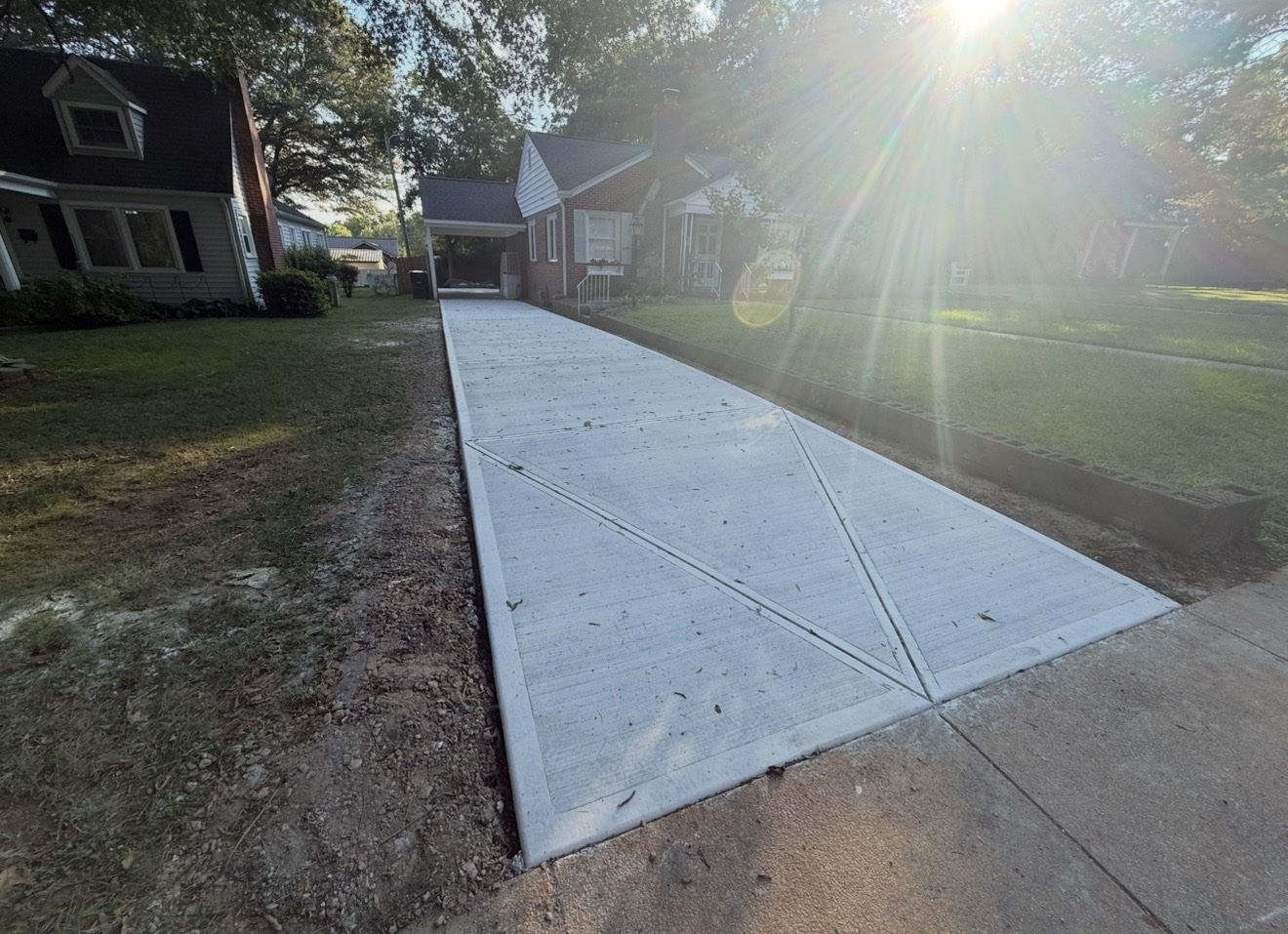
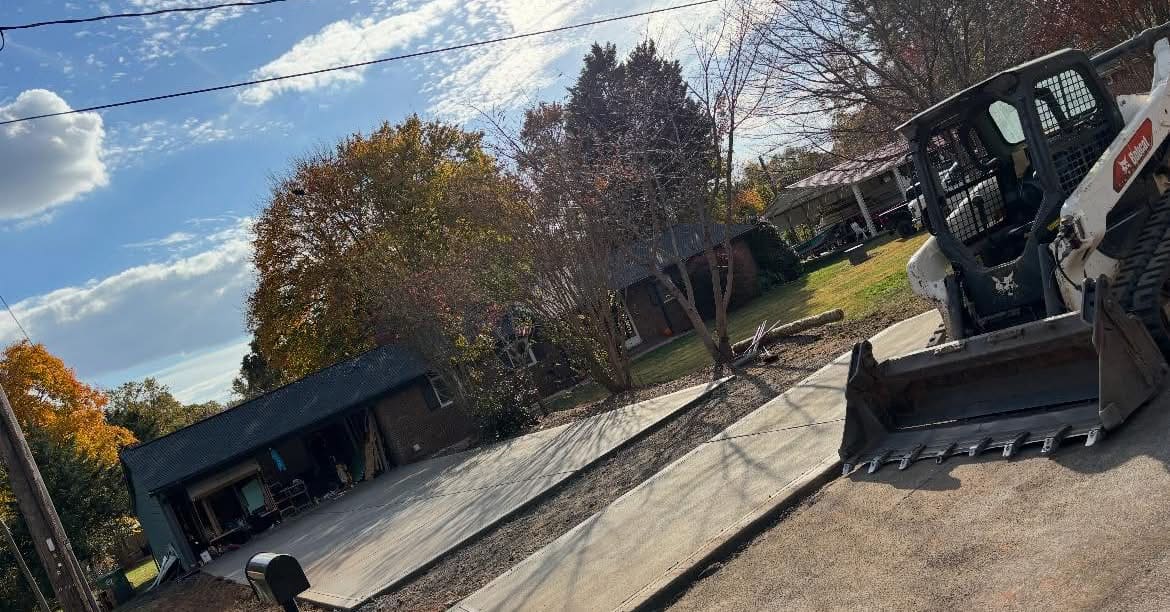
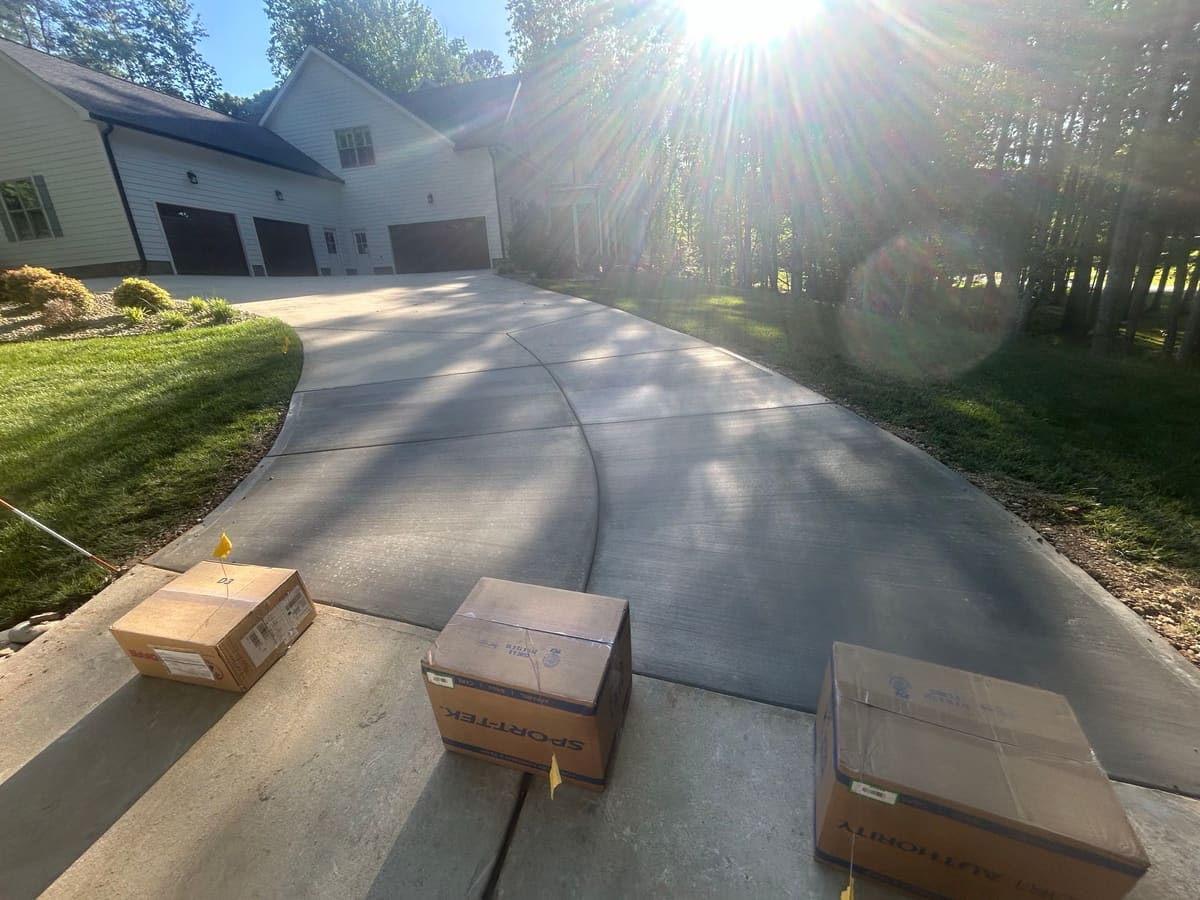
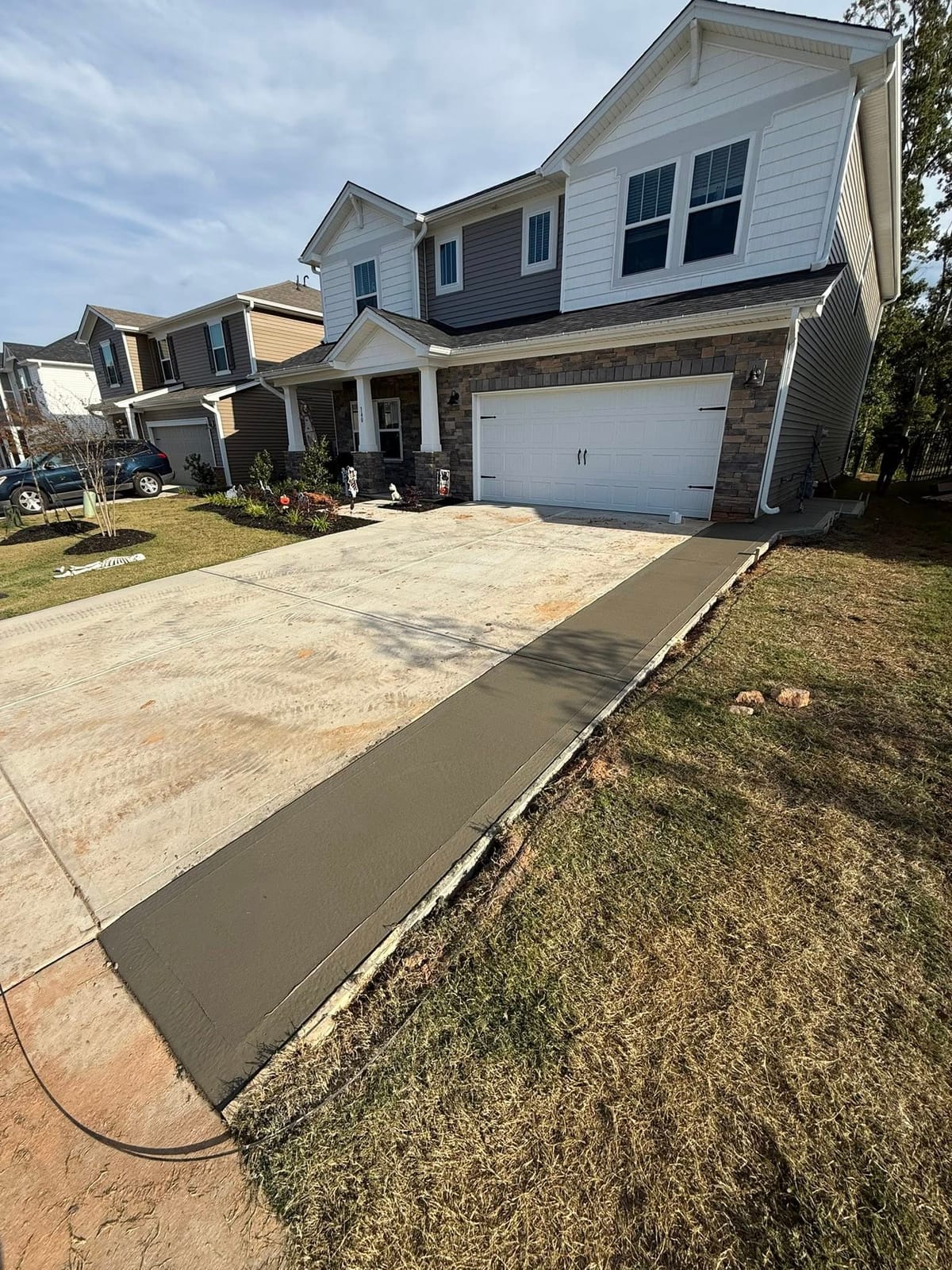
What Charlotte Customers Say
"Over 7 companies couldn't do the job and could not handle the scope of work, but they could and did an amazing job."
"They did it spot on! That was absolutely perfect to the specifications."
"Right from the beginning they answered my questions. It was an amazing experience."
Concrete Contractor Construction Portfolio
See the transformation. Drag the slider to reveal the restoration precision of our commercial and residential projects.
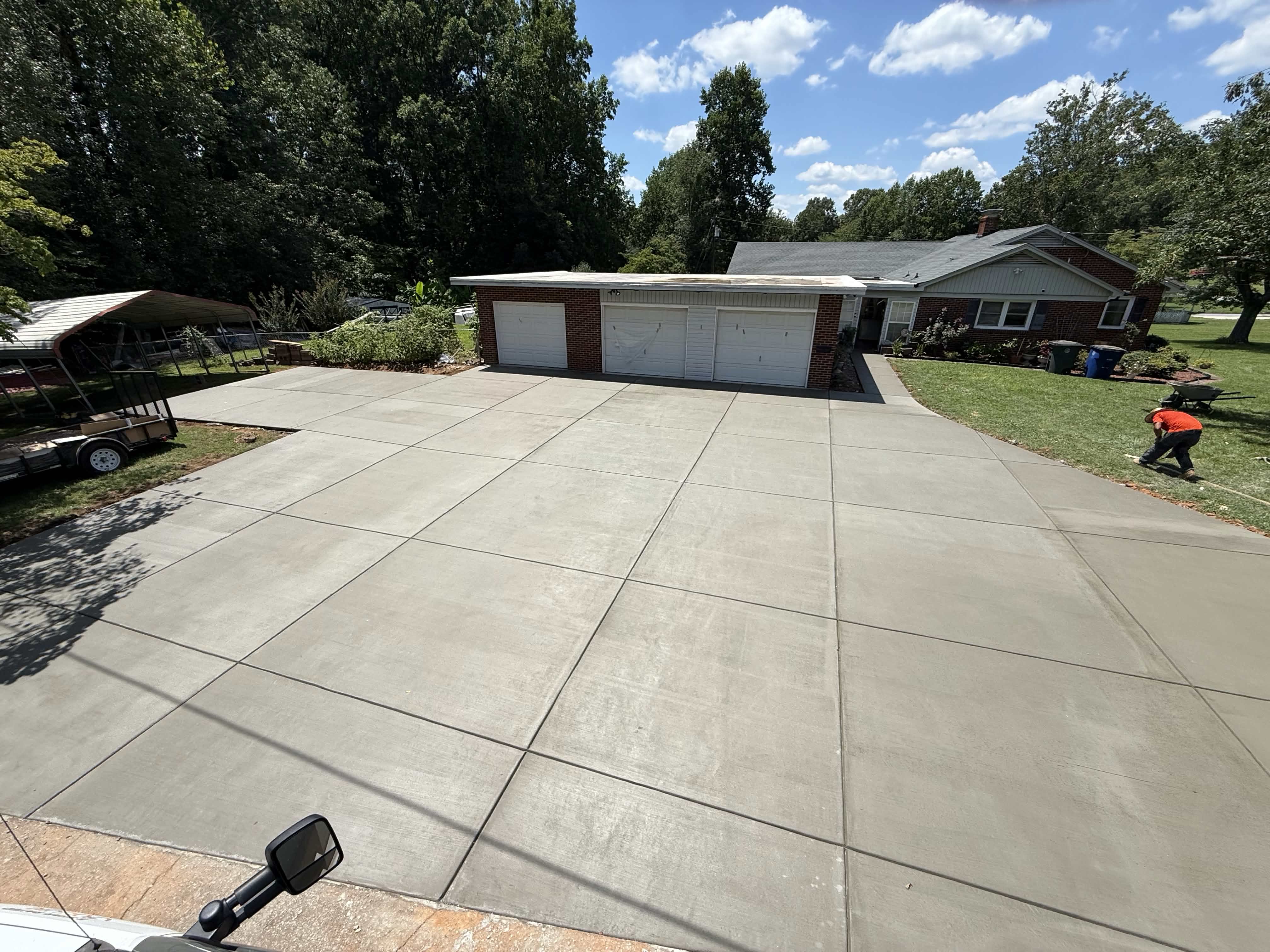
Finishing Touches in Motion
Watch our crew bring precision and artistry to the final stages of a premium concrete installation.
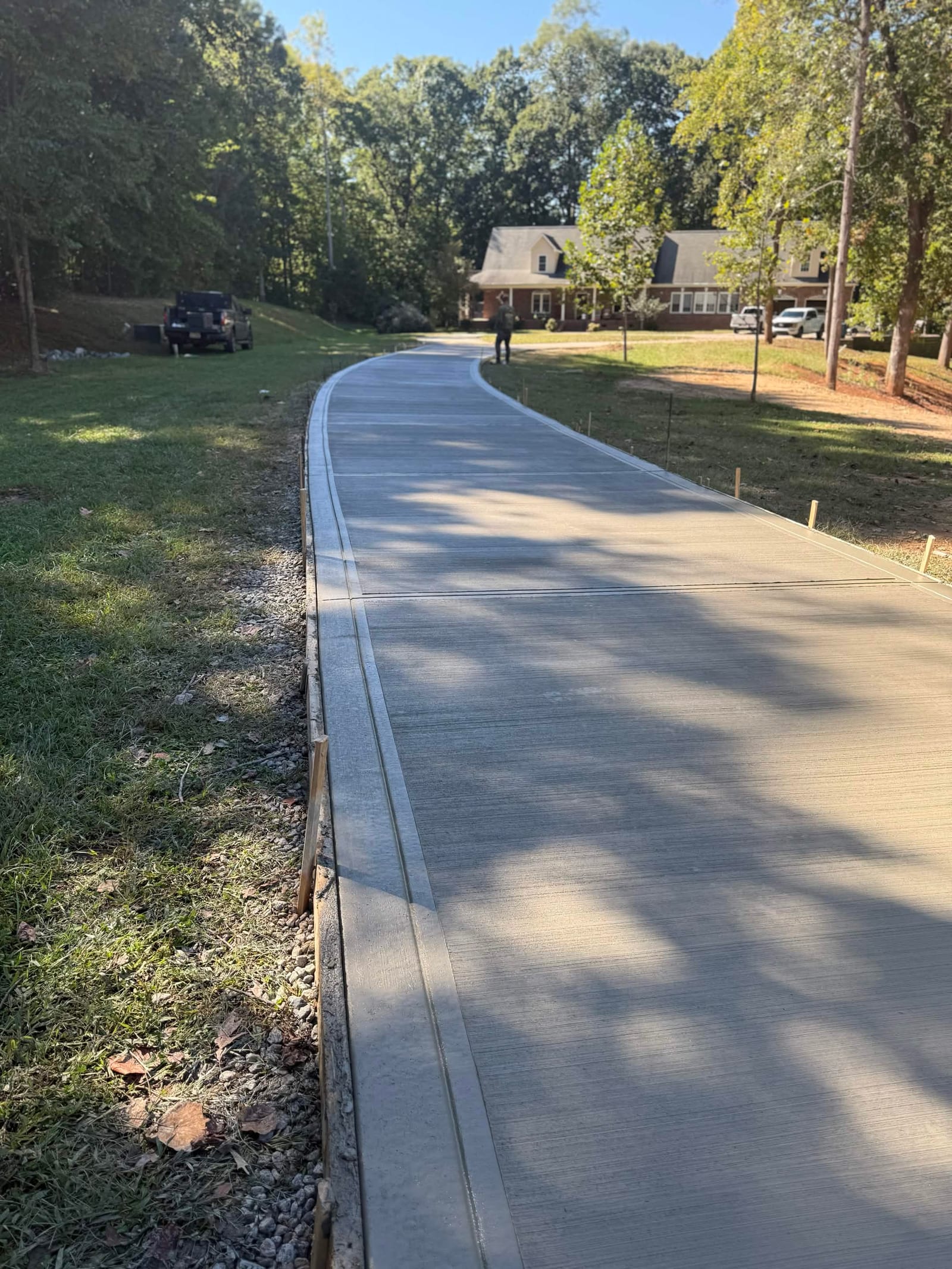
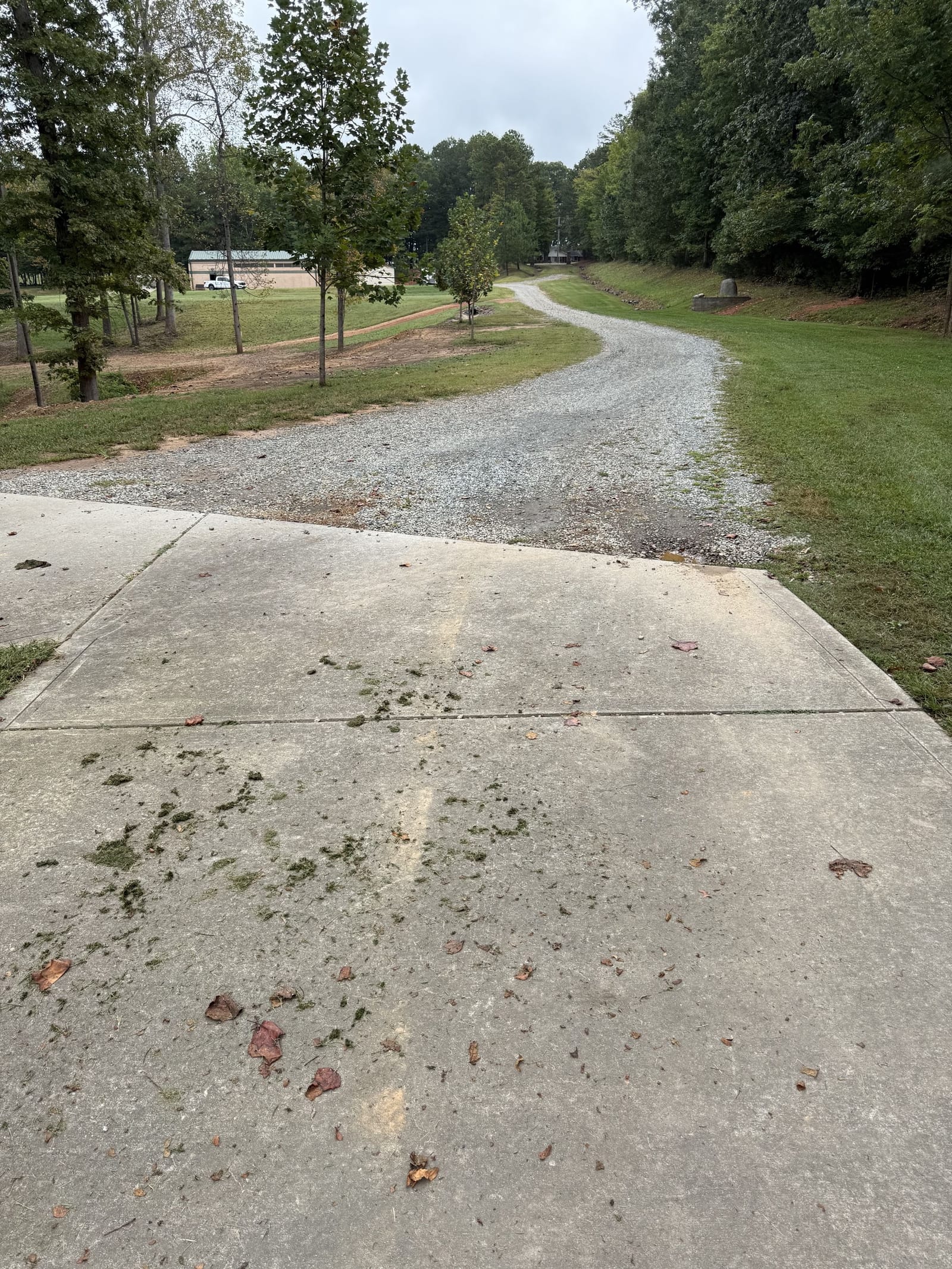
Driveway
Full residential replacement
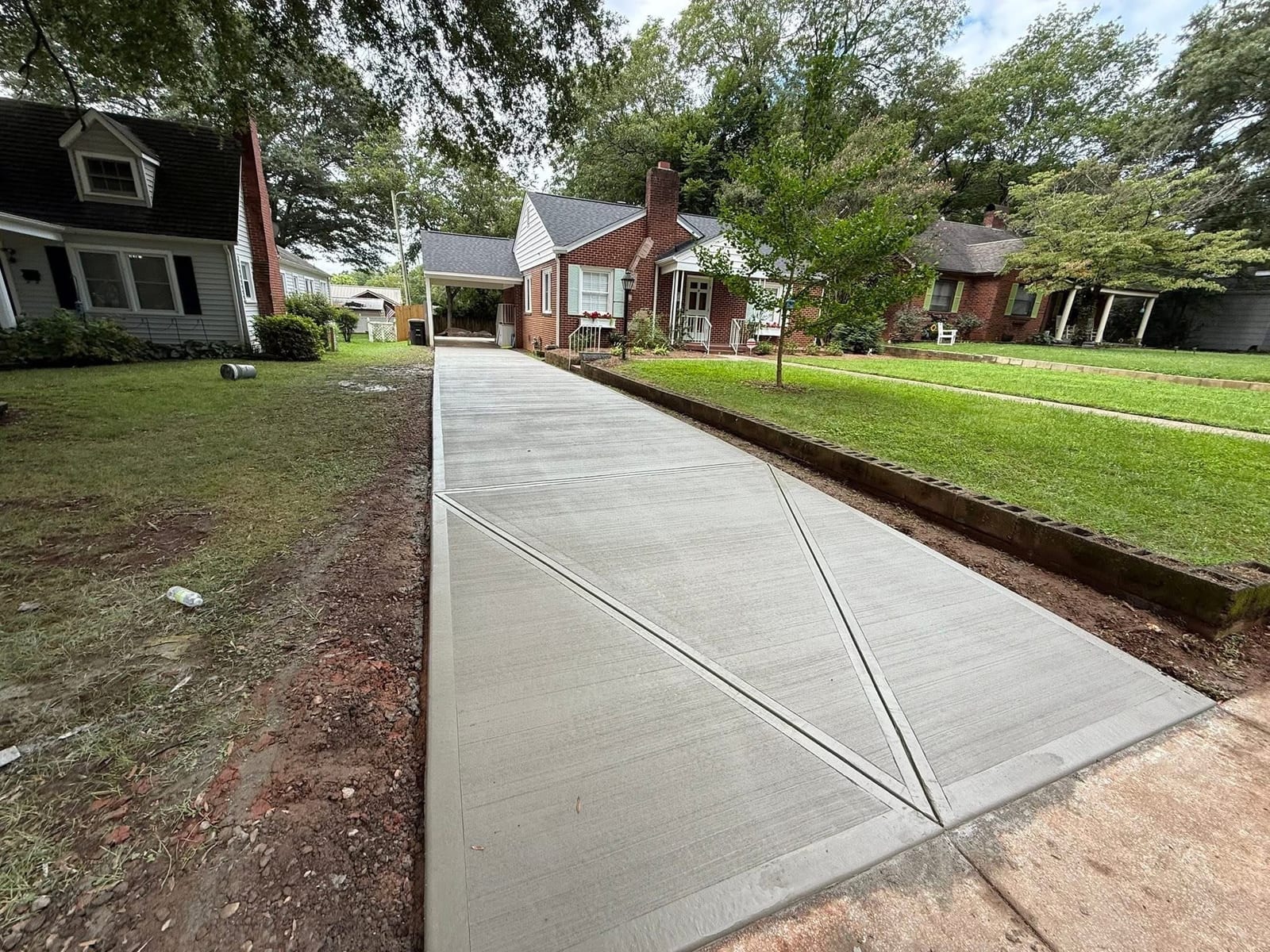
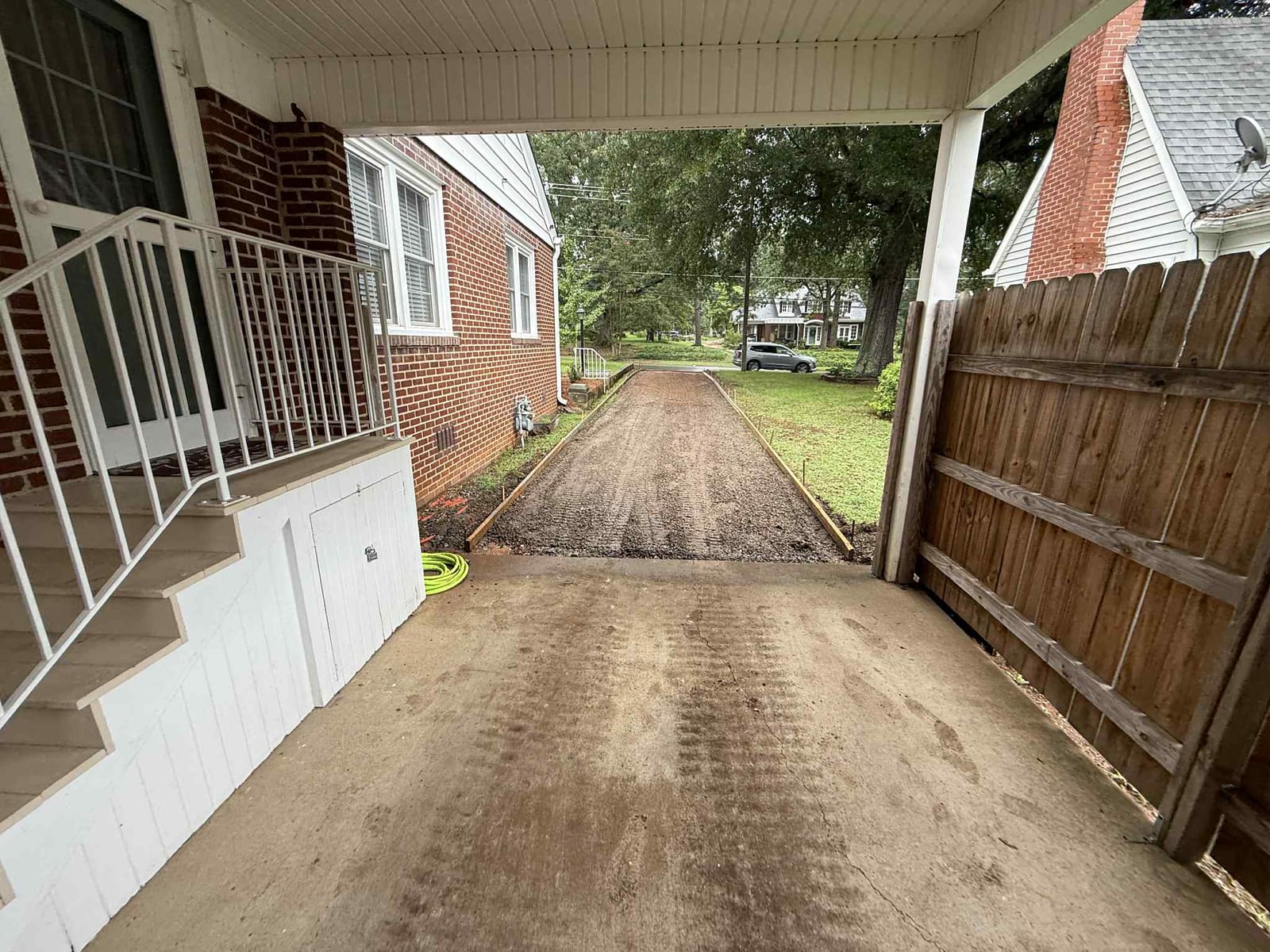
Driveway
Driveway revamp
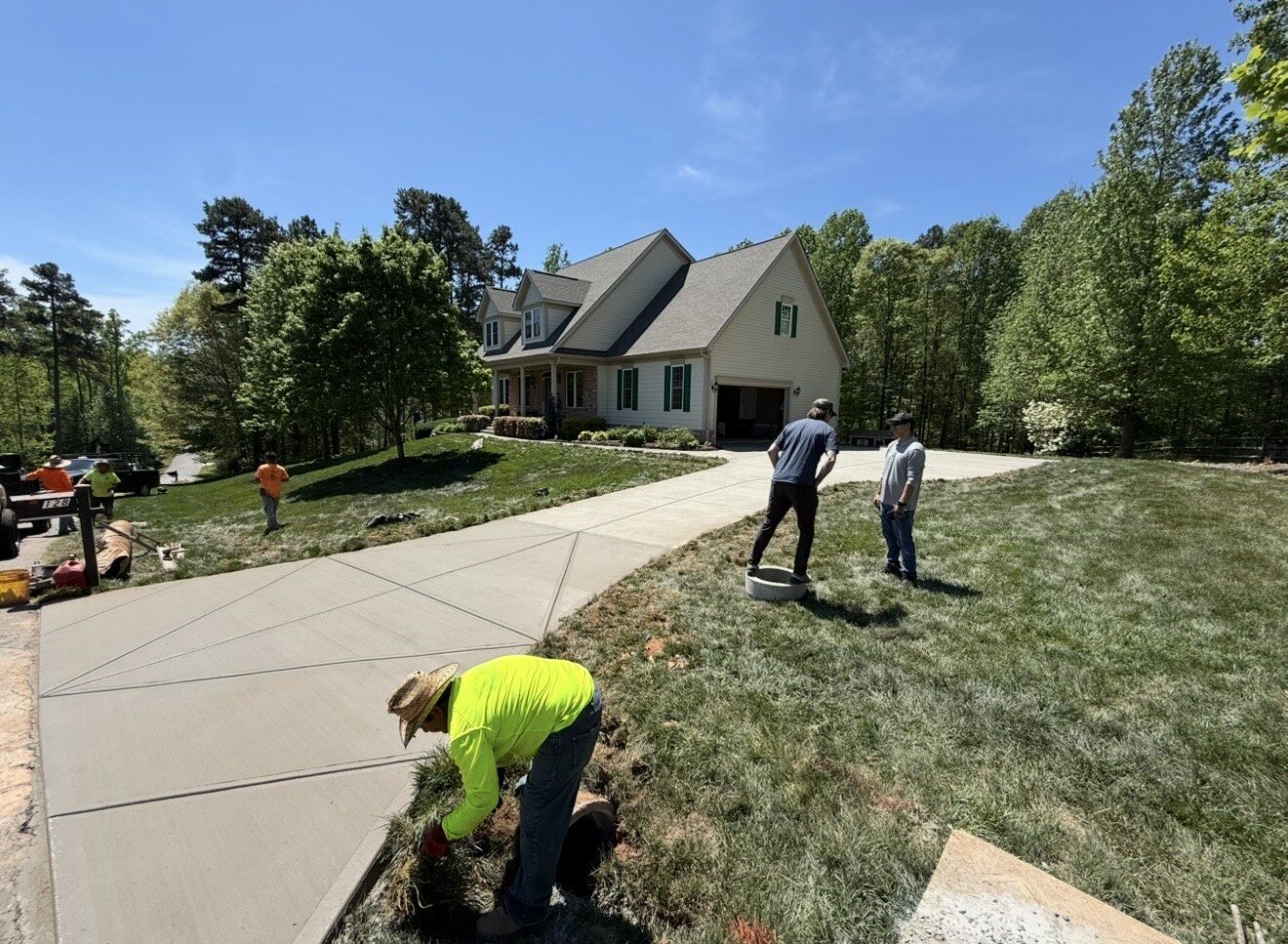
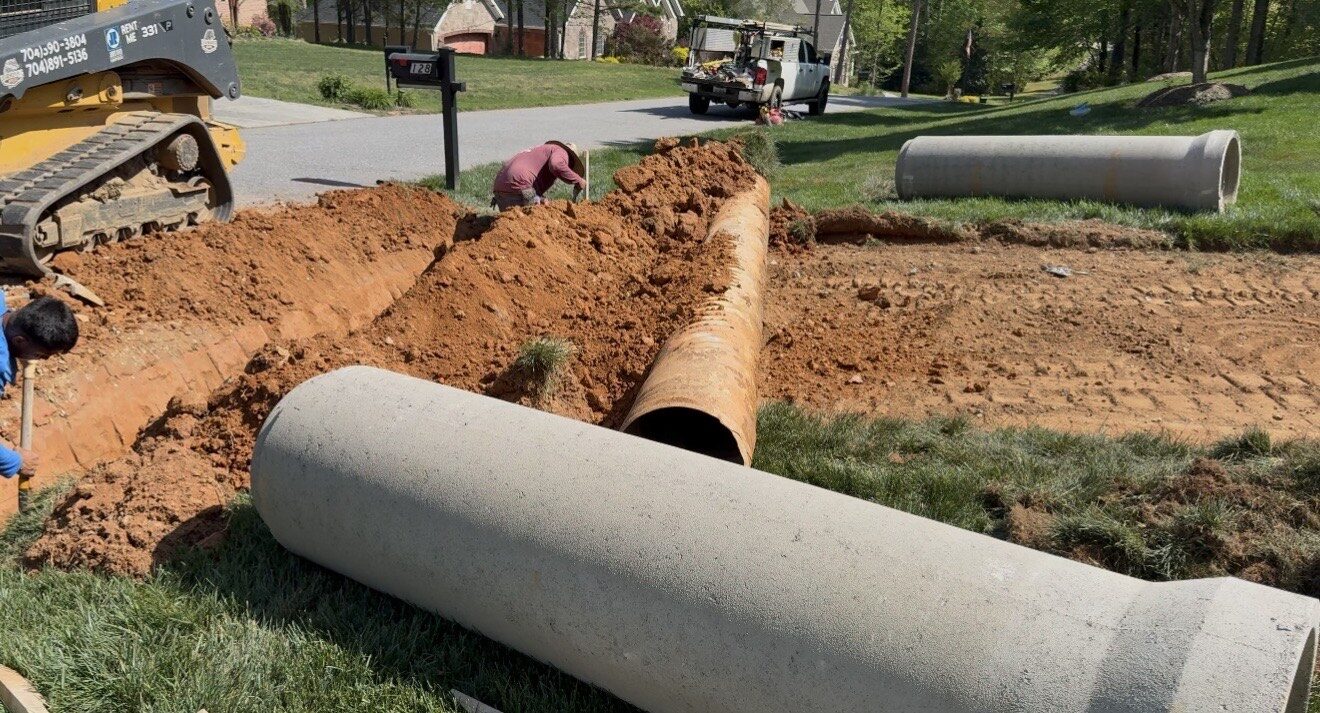
Driveway Replacement
Tear out + fresh pour
The Same Playbook on Every Charlotte Job
Every Charlotte job runs the same way: walk the site, compact the subgrade, lay out the steel, pour inside the right weather window, cut joints before the slab decides where to crack on its own. The address changes; the standard doesn't.
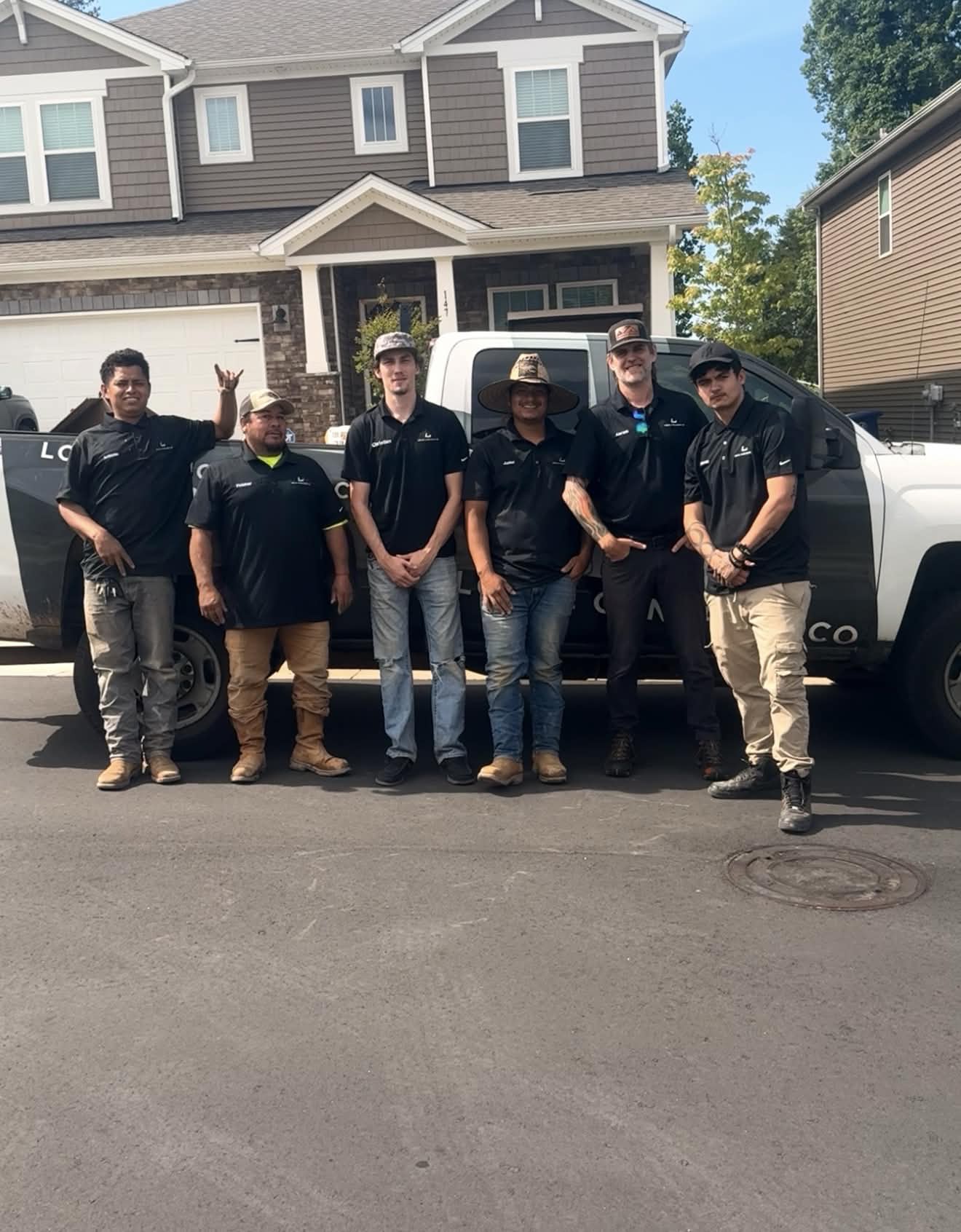
Walk the Site, Price It in Writing
It starts with boots on your Charlotte lot. We laser-measure the footprint, size up any tear-out and how the trucks will reach the pour, then put one firm number in writing and email it over. No verbal ballparks that drift once the work begins.

Locking In Your Pour Date
Your Charlotte slot goes on the calendar only after crew, pump, and a clean weather outlook all line up. If a storm system shows up in the forecast near pour day, you get a call and a new date before it becomes a problem — not an apology after.
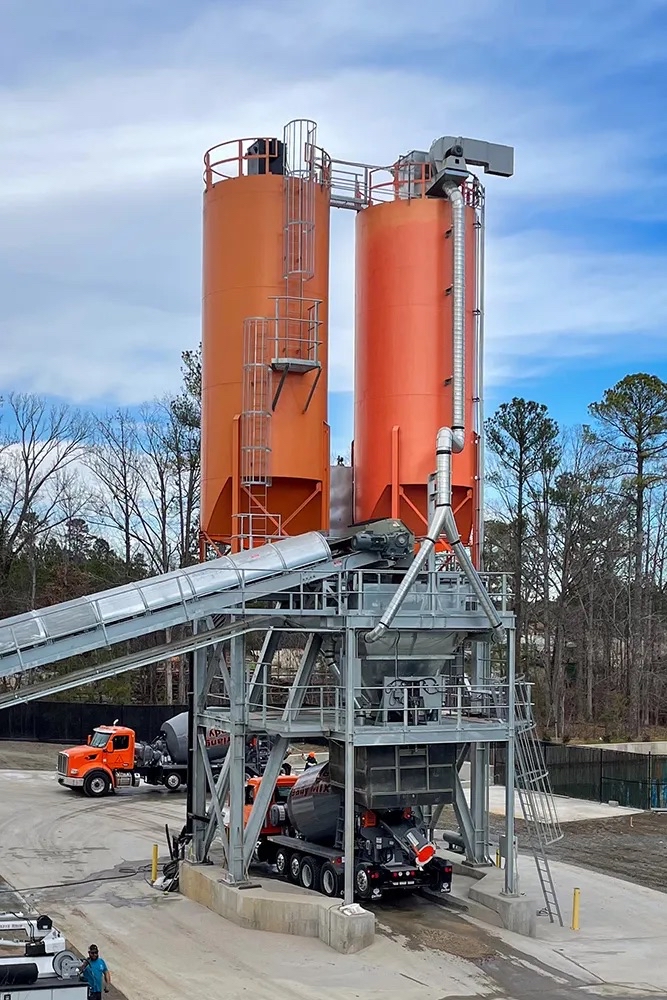
Dialing In the Mix
NC weather swings from muggy summer heat to genuine winter freezes, and the concrete has to be batched for the day it's placed. We call the plant ahead of your Charlotte pour with the slump range, the entrained-air target, and any retarder the conditions call for.
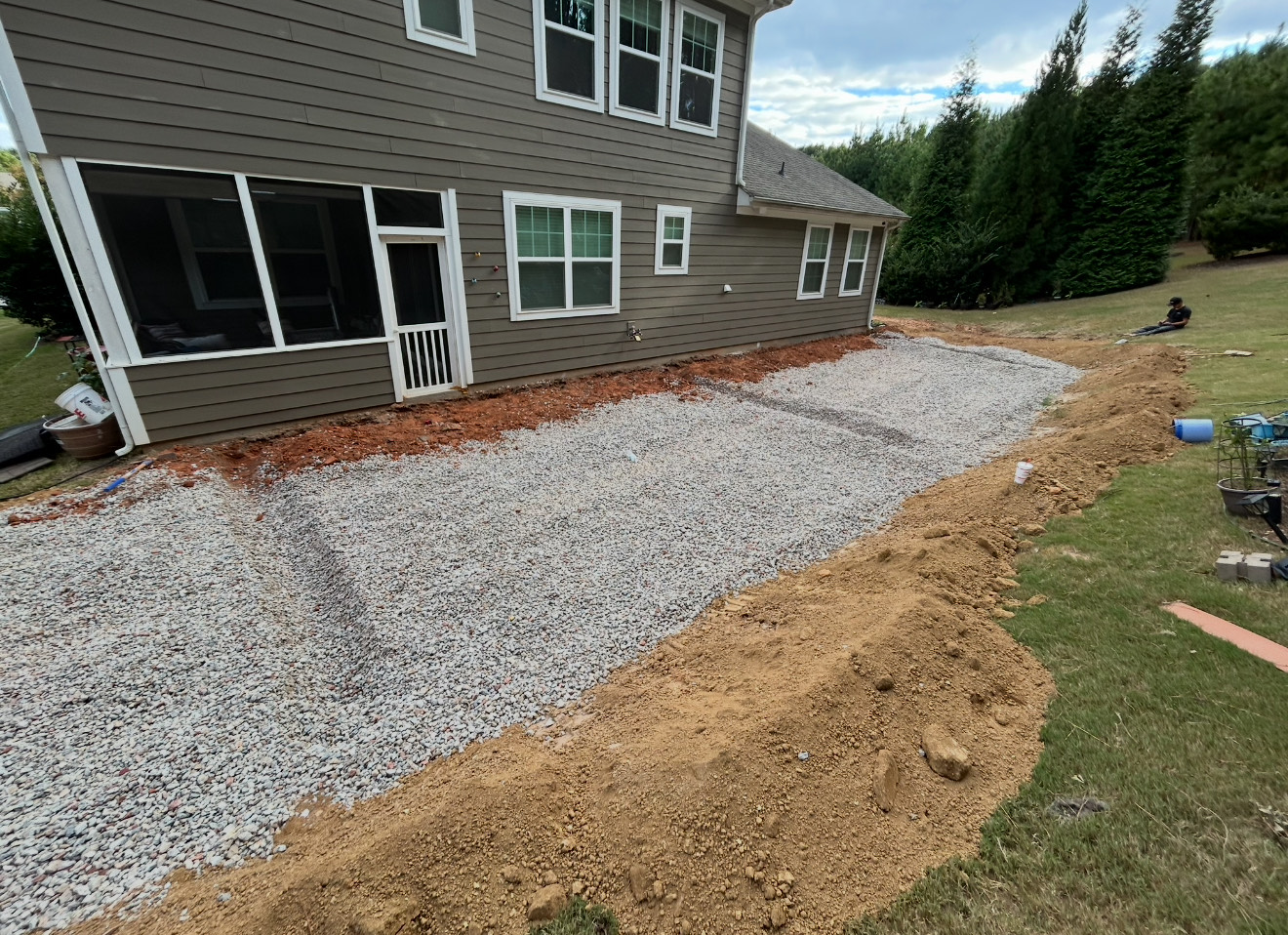
Protecting the Property First
Before any concrete moves, plywood goes down over lawn the pump line will cross and tarps cover the beds near your Charlotte pad. The pump operator and the foreman agree on the approach route in advance, so nothing on your property pays for our access.
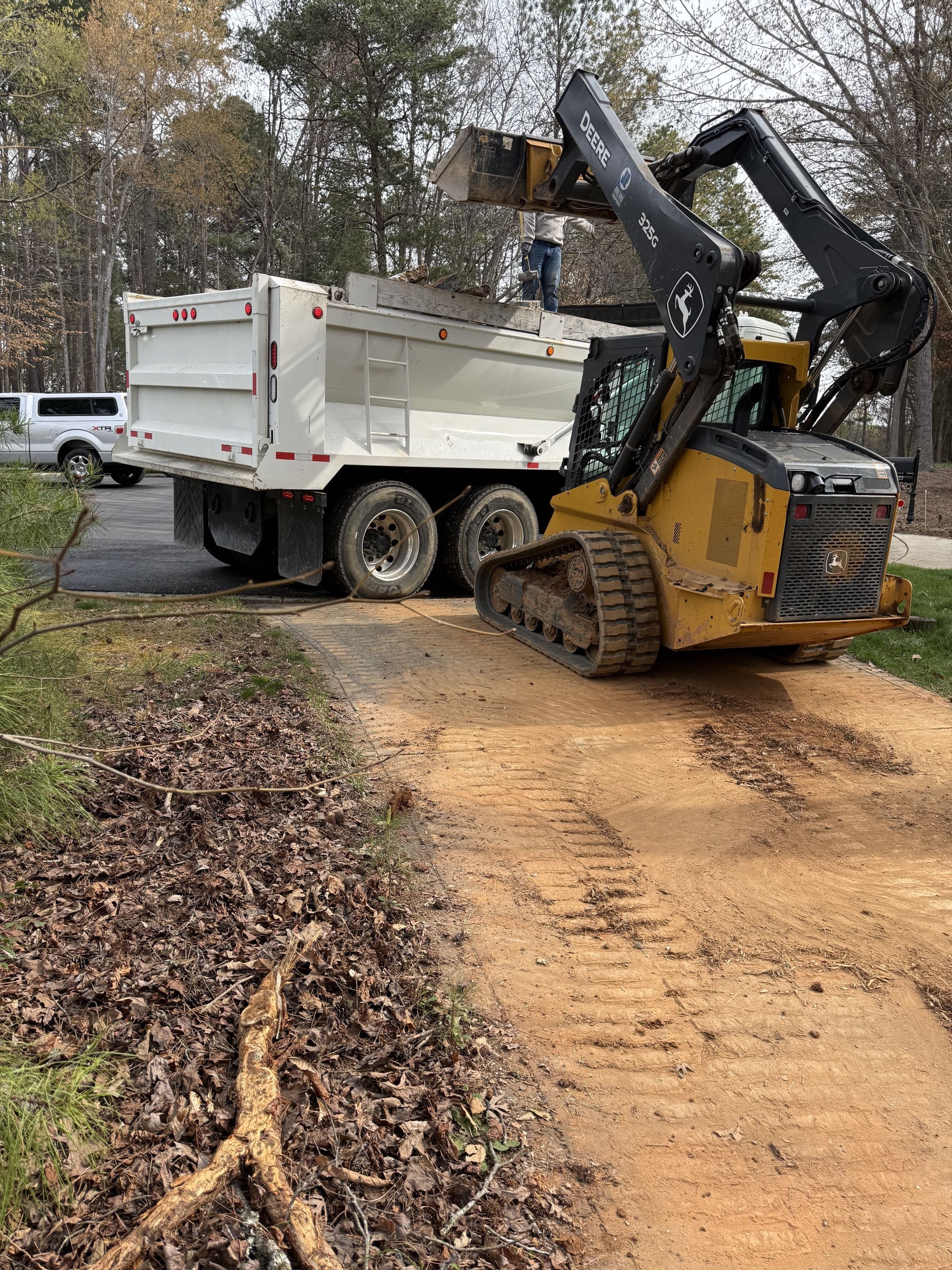
Tearing Out the Old Slab
A hydraulic hammer breaks up most old concrete at your Charlotte address; heavily reinforced sections get saw-cut into panels and pried loose. The skid-steer runs every piece straight into the dump truck, so the debris leaves the same day it comes up.
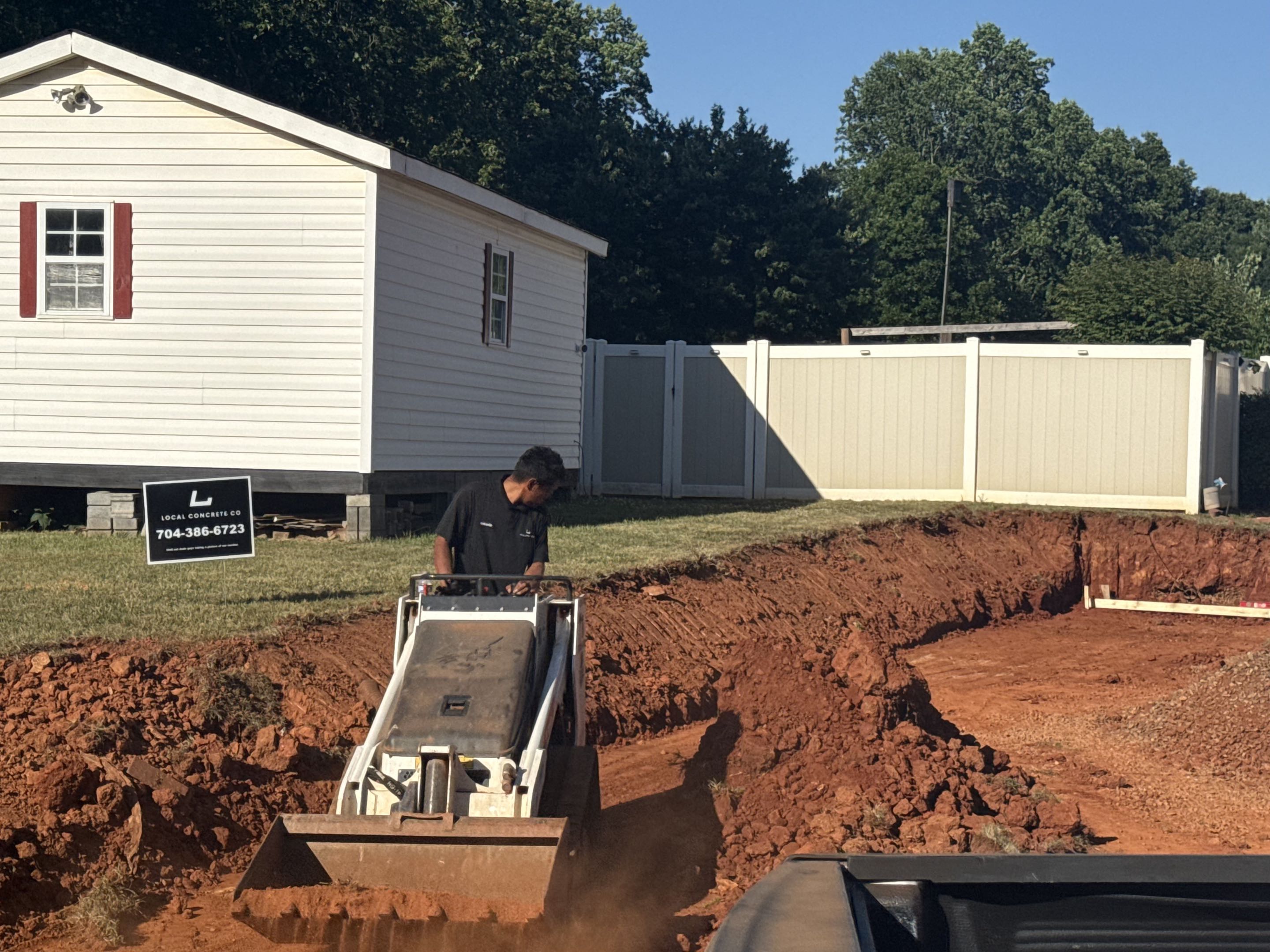
Base, Grade, and Forms
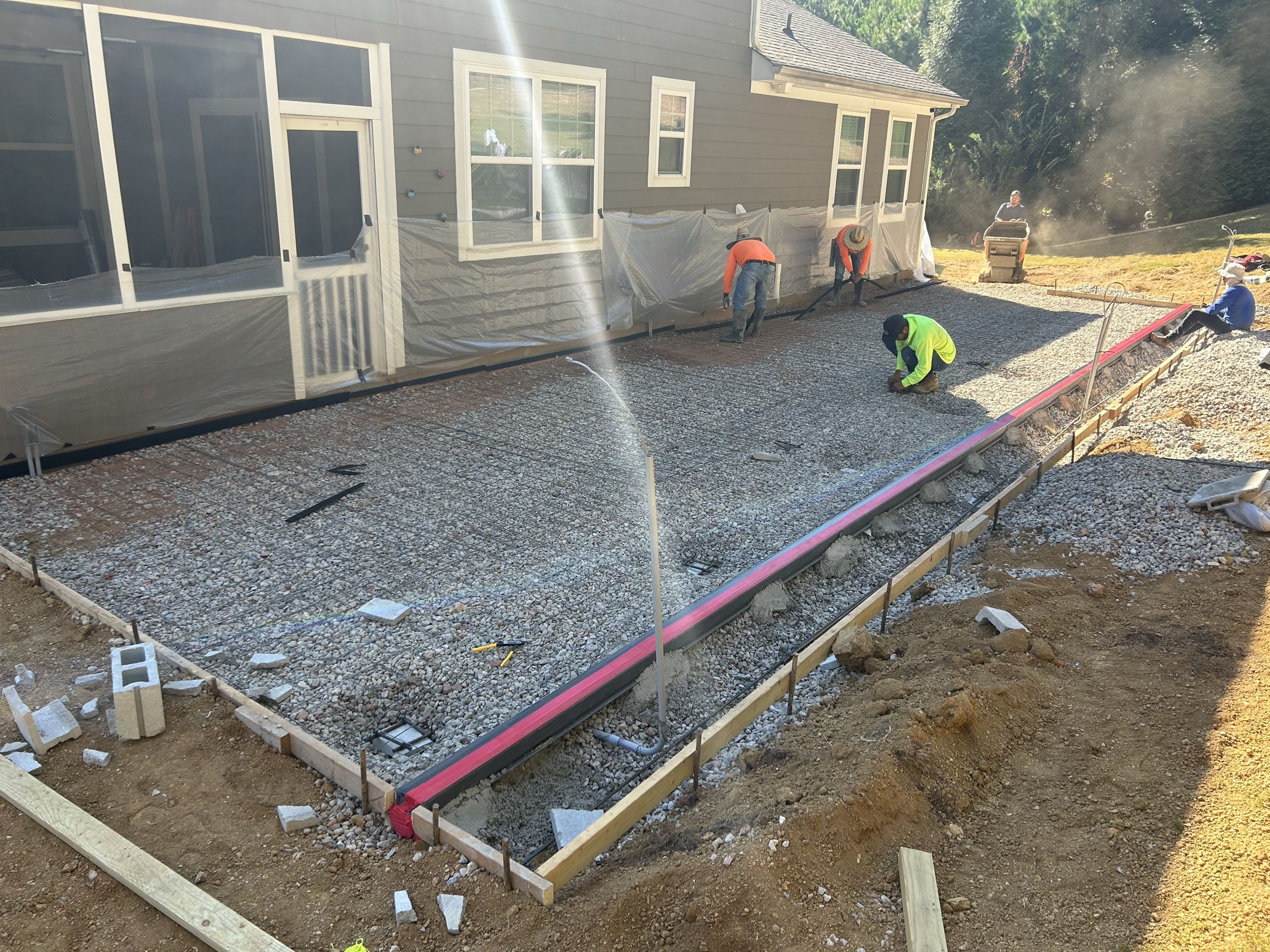
Red clay swells when it's wet, so every Charlotte subgrade gets a compacted #57 stone base placed in lifts before forms go up. The laser confirms fall away from the foundation — 1/8 inch per foot at minimum — and the forms get staked so a full pour can't push them.
Steel in the Slab
#4 rebar gets tied into a full grid on 18-inch centers and propped on chairs, so the steel rides mid-slab where tension actually lives. Wire mesh tends to end up flat on the bottom of a pour doing nothing — over the shrink-swell clay under Charlotte lots, we won't install it.
Walkthrough Before the Trucks Roll
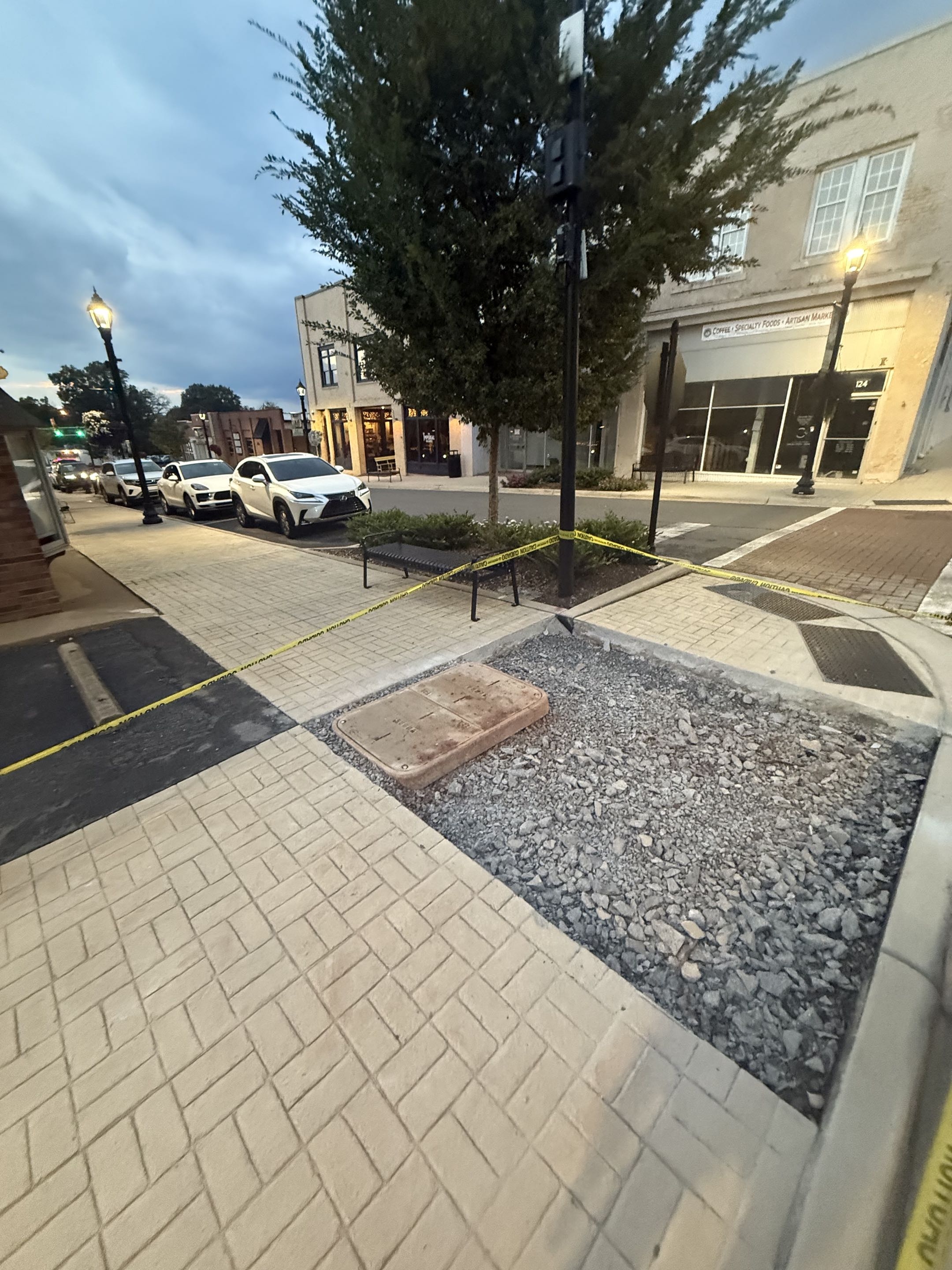
You and the foreman look over the Charlotte formwork together before any concrete arrives. Elevations get rechecked with the laser, the rebar grid gets photographed for the job file, and the drainage pitch gets verified. Changing something now is free; changing it after the pour means demo.
Testing Every Truck
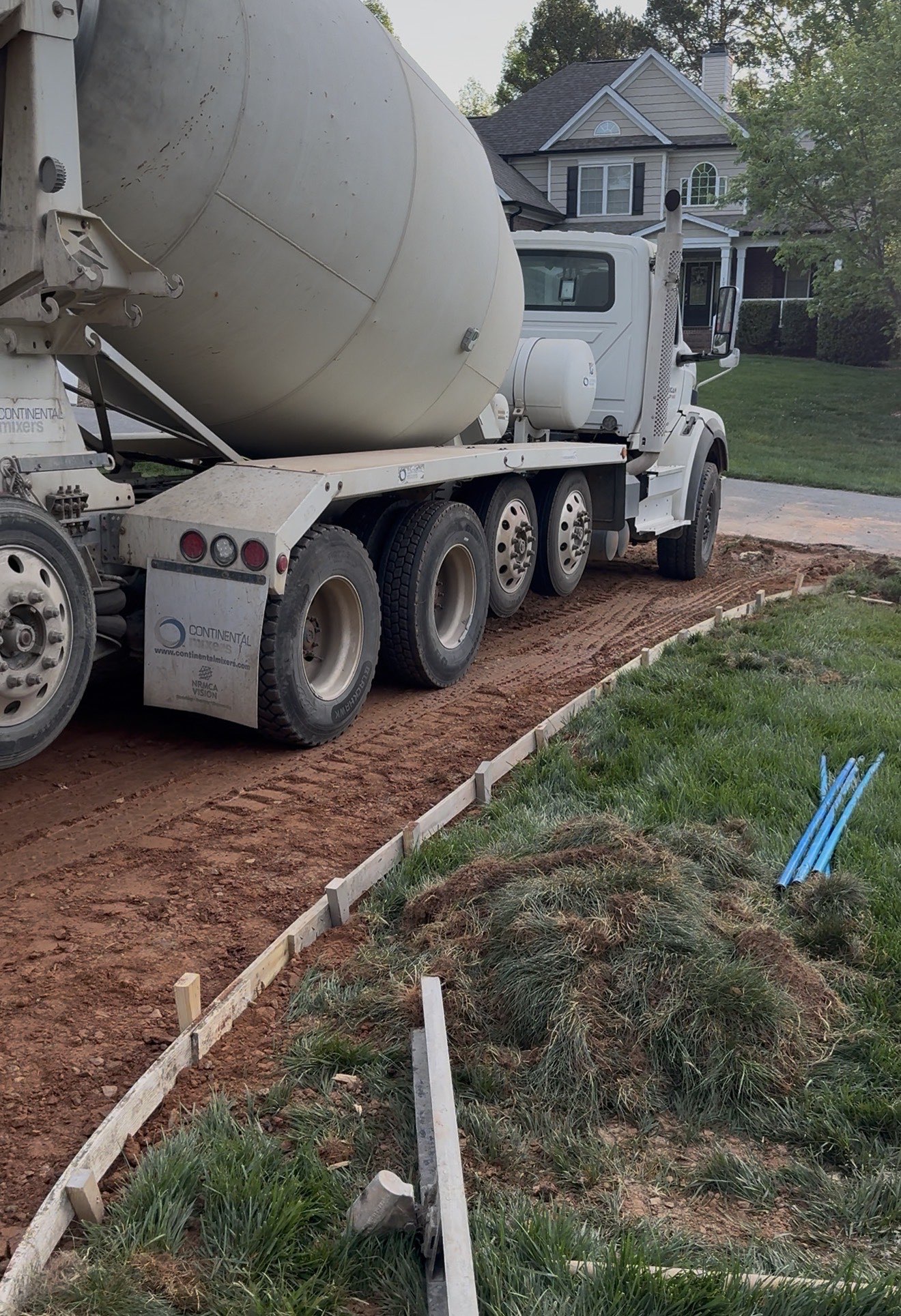
The first concrete out of each truck at a Charlotte job gets slump-tested right at the chute and checked against the batch ticket. Out of spec? That truck turns around. We'd rather stand and wait on the plant than bury a bad load in your slab.
One Continuous Pour
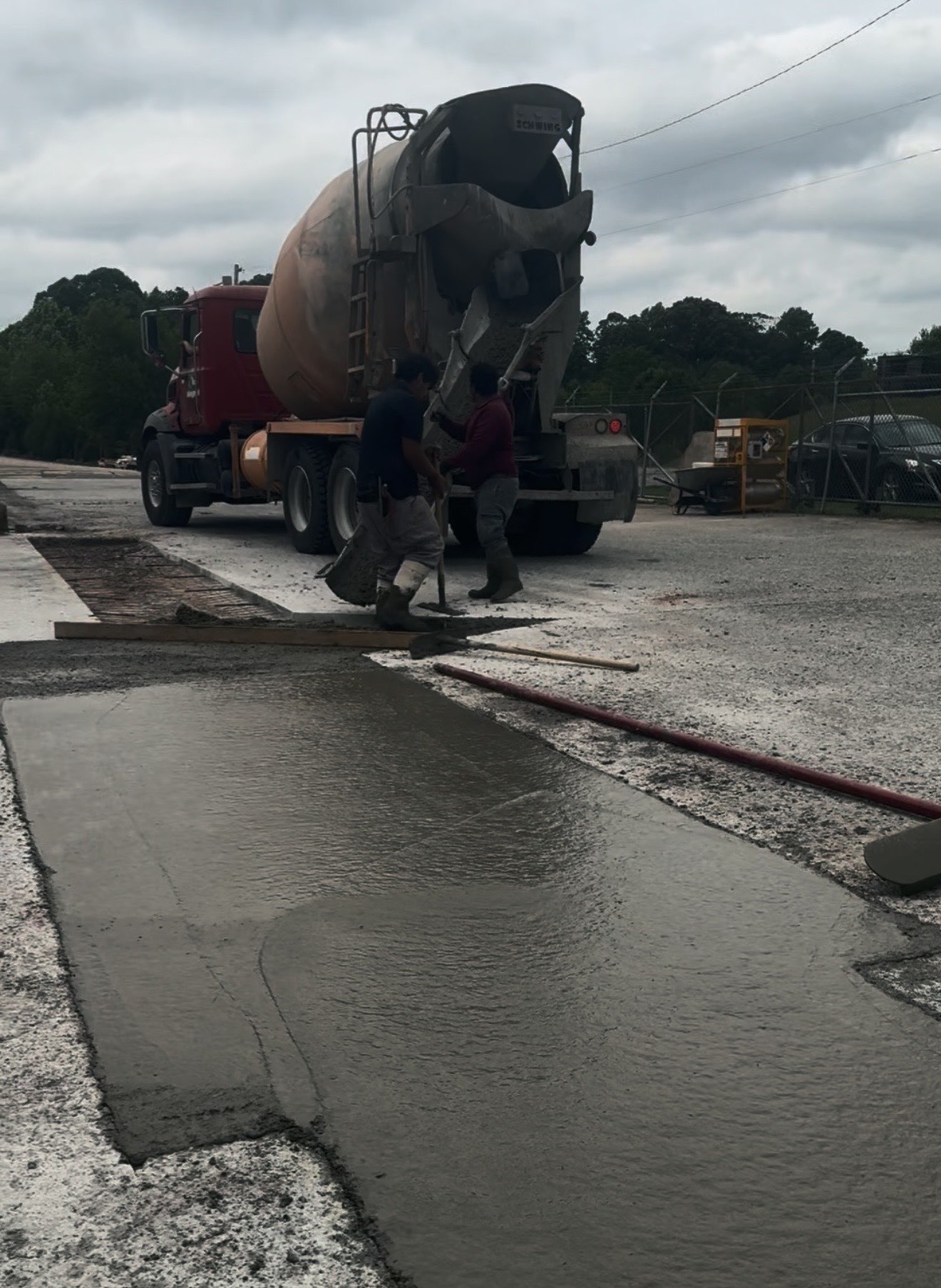
Concrete moves across your Charlotte section in a single direction with the screed working right behind it, so fresh material always lands against a wet edge. That rhythm is what prevents cold joints — the weak seams that form when a pour stalls and one edge sets before the next truck ties in.
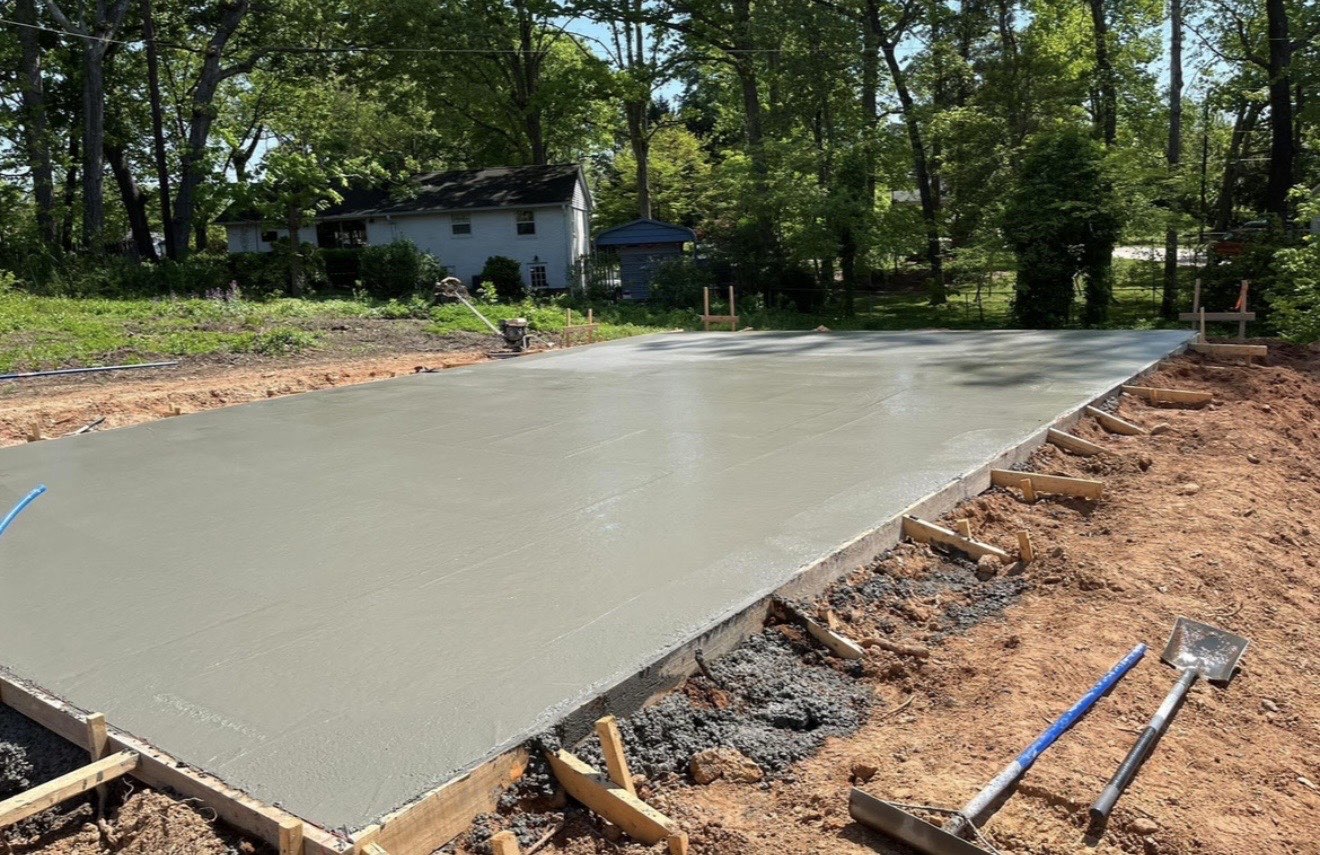
Floating the Surface Flat
While the concrete is still workable, the bull-float follows the screed to press rock down and draw paste up, closing the surface. Get this pass right and your Charlotte slab reads dead flat in raking light. Get it wrong and no later step can hide it.
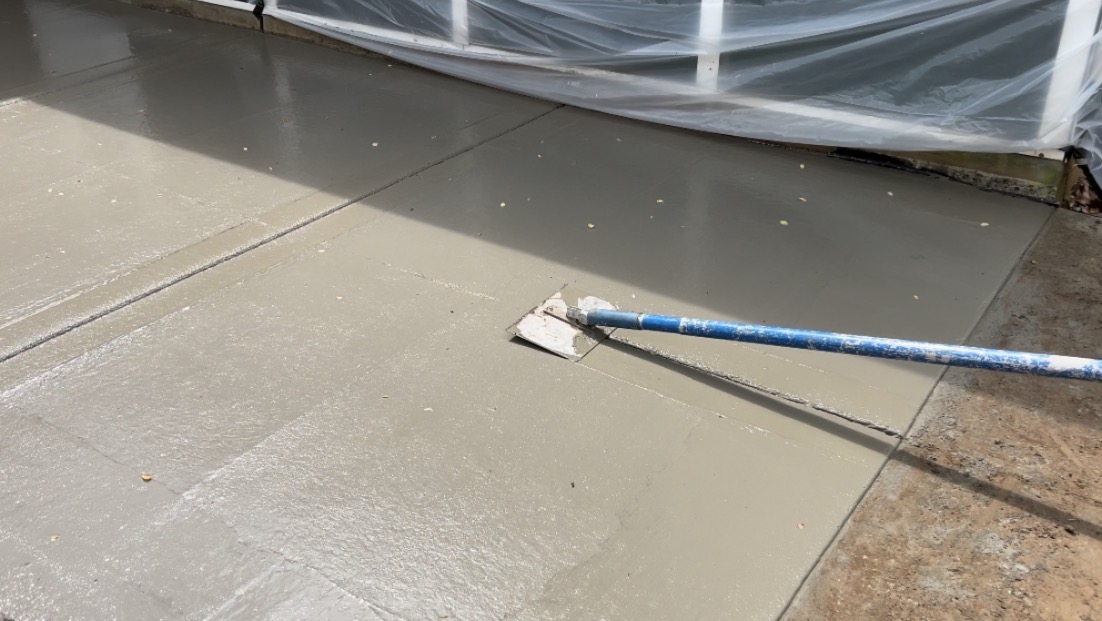
Edges Tooled, Joints Cut on Time
Every exposed edge gets rounded by hand so it won't chip under impact. Then the saw comes out: control joints go in within 4 to 8 hours of finishing, spaced to match the slab's thickness. Miss that window over reactive Charlotte clay and the slab picks its own crack lines. We don't miss it.
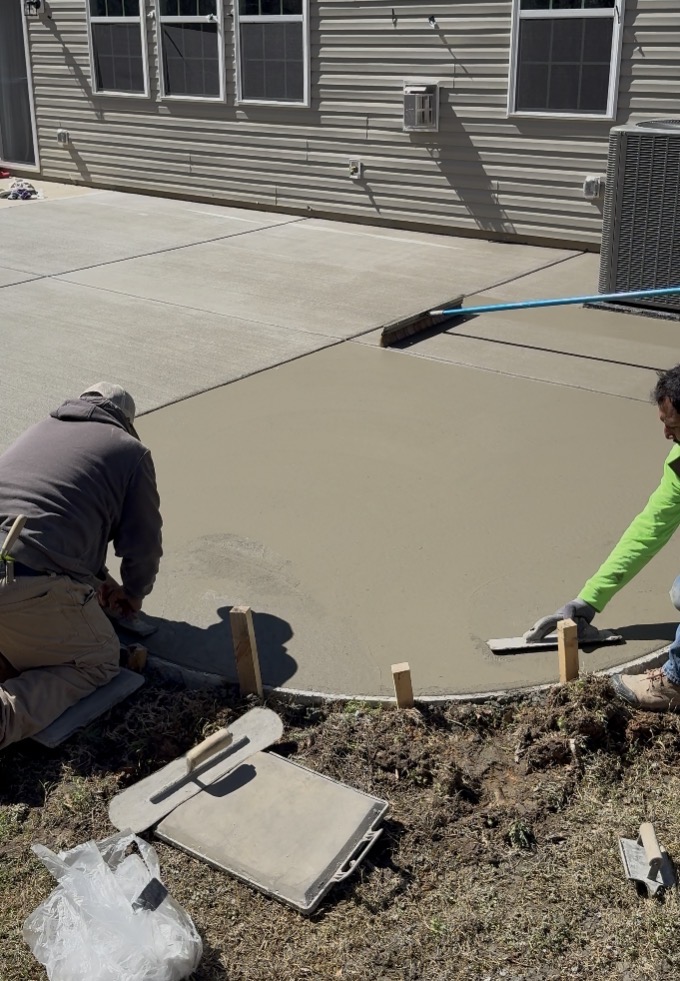
The Fresno Pass
A wide Fresno trowel on a long handle takes the surface down a final level of smooth, erasing the minor waves the float leaves behind. Knowing when a Charlotte slab is ready for that pass — and when to leave it alone — is finisher's judgment you only earn on the tool.
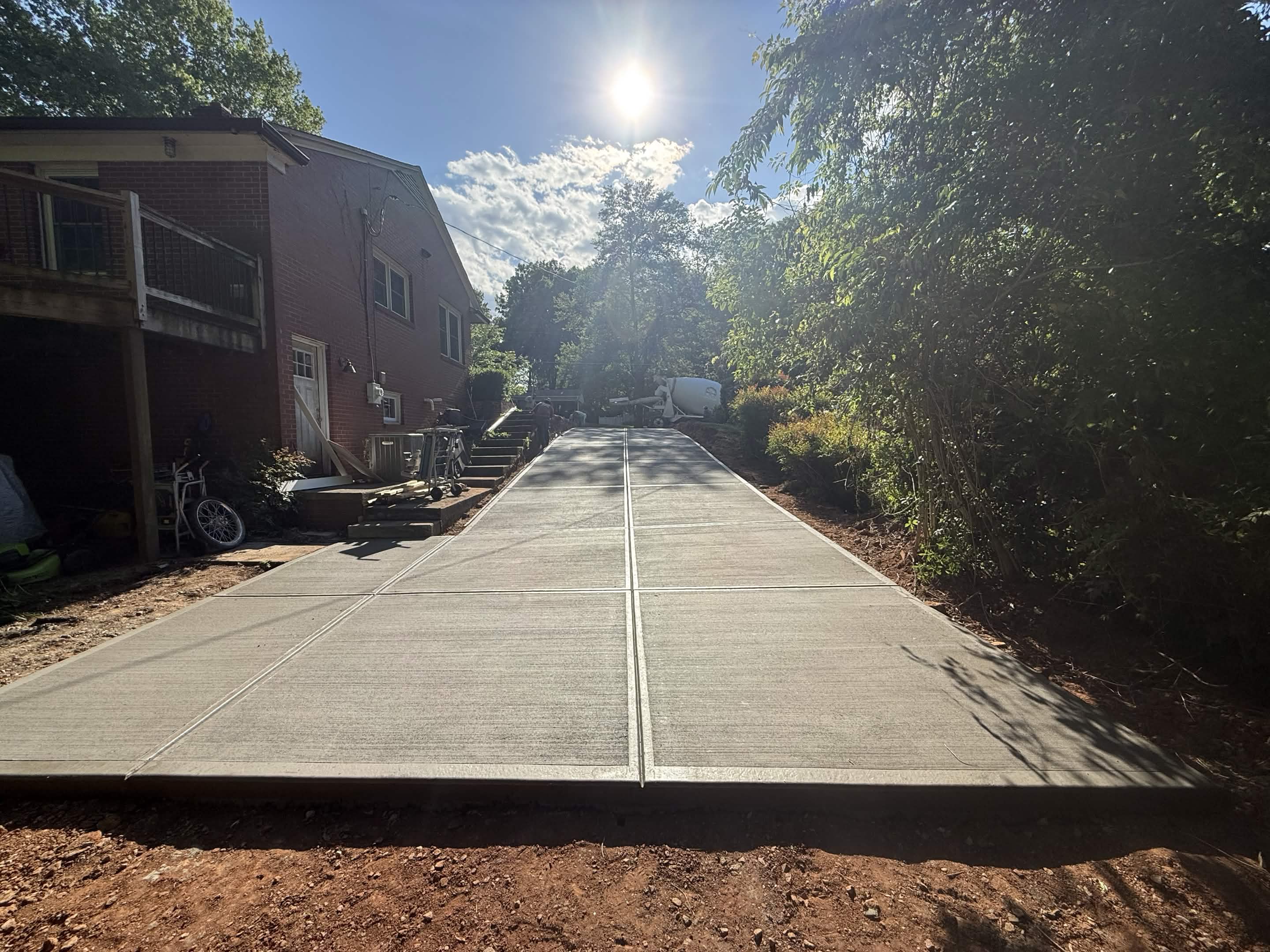
Your Finish: Broom, Stamp, or Exposed
Driveways at Charlotte homes get broomed across the direction of travel so tires bite. Stamps go down while the surface is just firm enough to hold a crisp impression. For exposed aggregate, we time the surface retarder and washout to how fast that particular day is drying things.
Stripping Forms, Dressing Edges
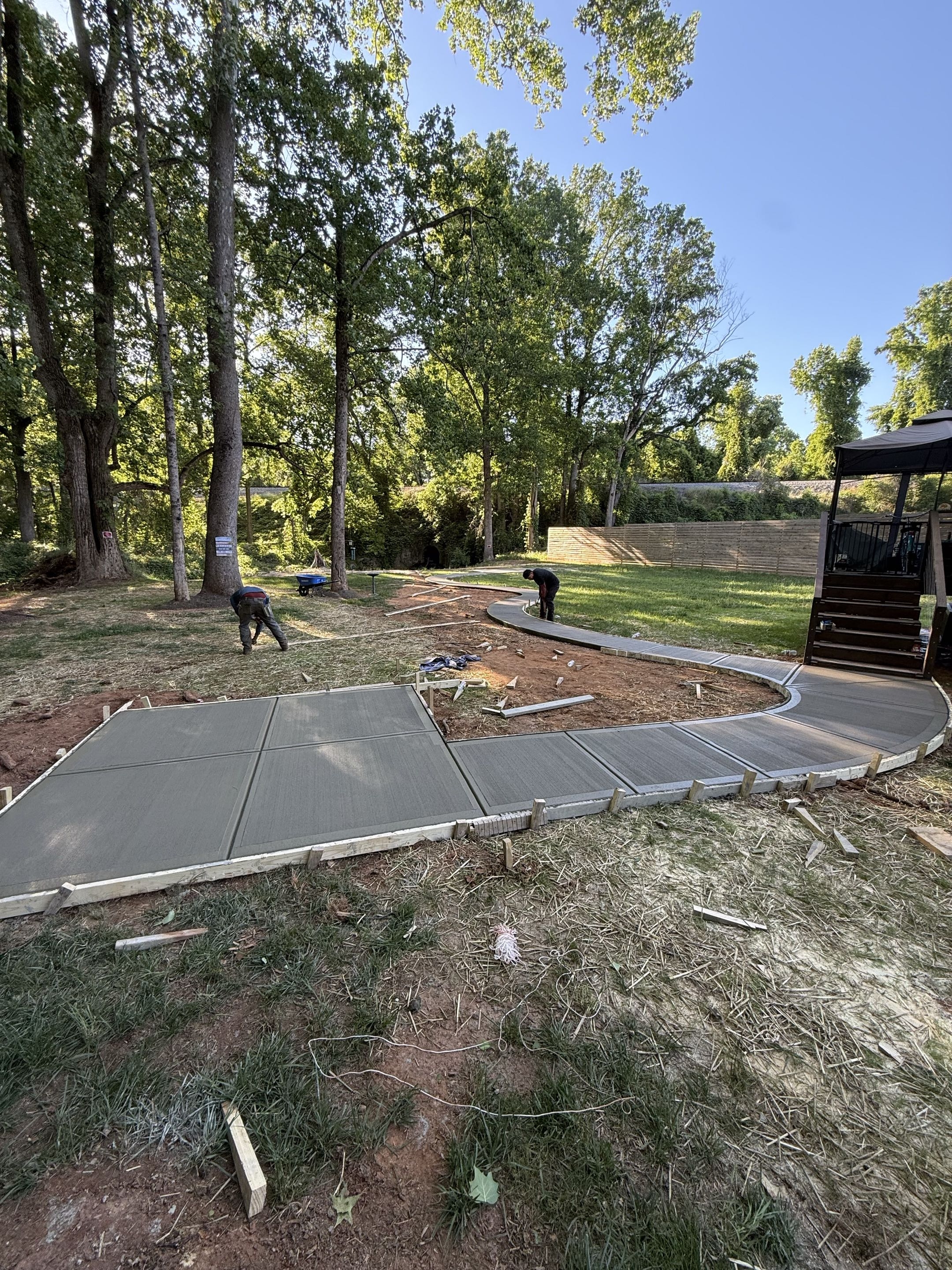
Forms stay on your Charlotte pour a full day before they come off — strip early and green edges crumble, strip late and the stakes lock in. Once they're off, we chip away any flash, tool a clean chamfer along every exposed edge, and haul the lumber out.
You Sign Off Before We Bill
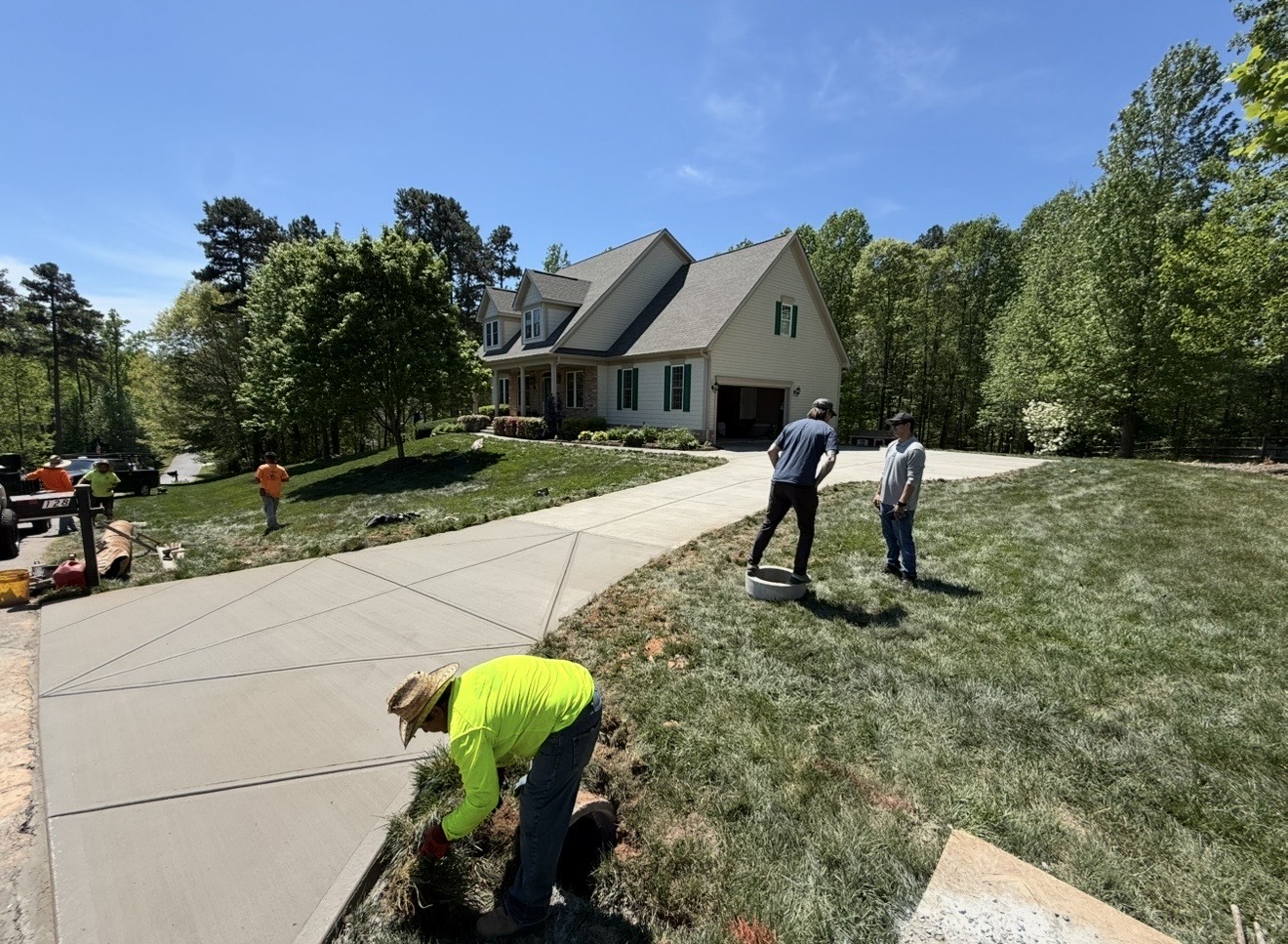
The job isn't done until you've walked the whole Charlotte slab with the foreman and had every question answered — a joint, a texture line, an elevation, all of it. Only after you're satisfied does the invoice go out. Payment on completion isn't a slogan here; it's the sequence.

How to Treat Your New Concrete
You keep a written care guide: stay off the slab for 48 hours, keep cars off for 7 days, and hold heavy loads until the full 28-day cure. It also covers the no-deicing-salt rule for the first winter, plus when a stamped Charlotte surface will want resealing.
Cleanup, Warranty, Done
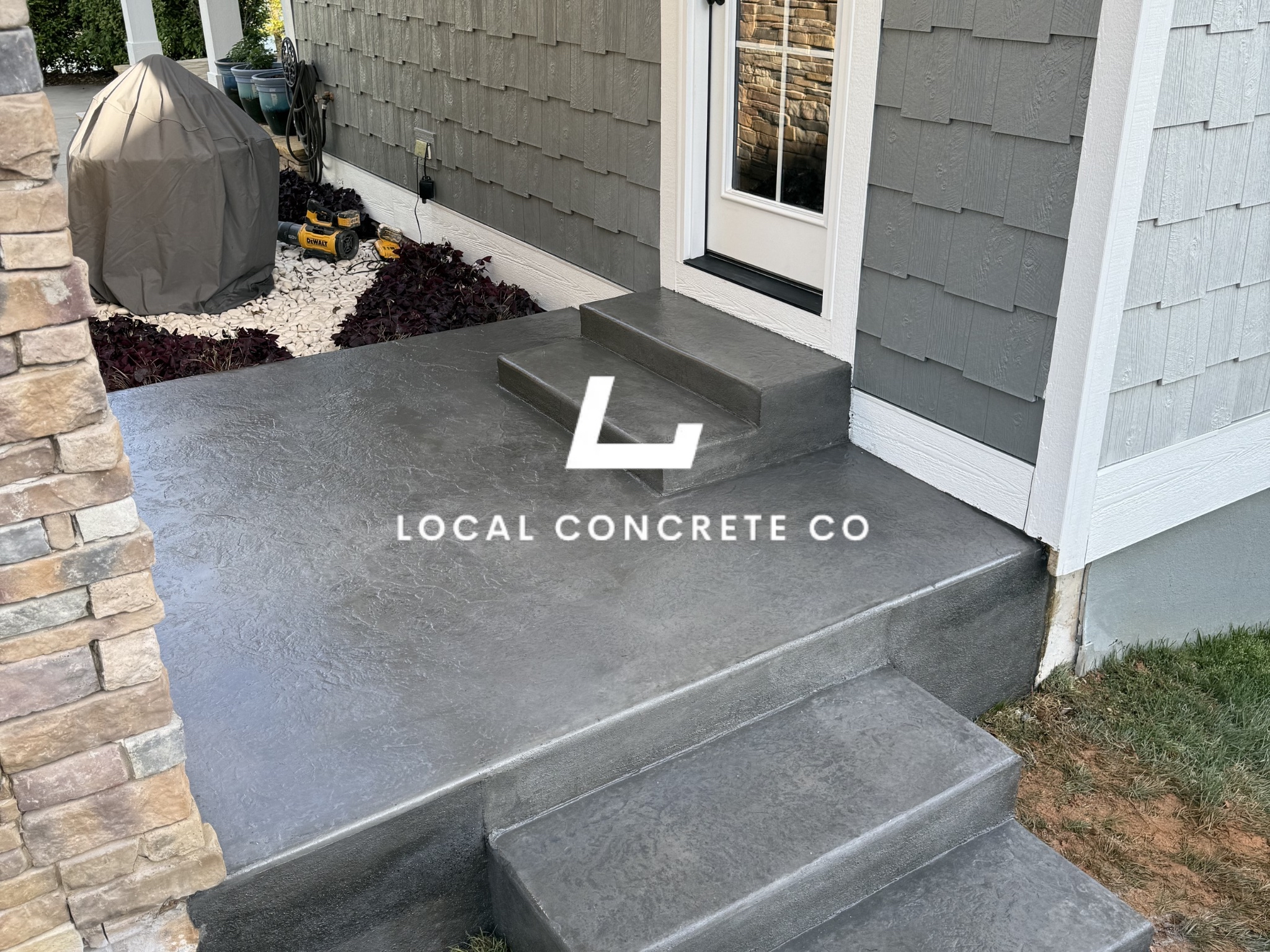
The last truck leaves with the last of the debris, your Charlotte site gets squared away neater than we found it, and the workmanship warranty arrives in writing by email. Signed walkthrough, cleared site, delivered warranty — that's what complete means on our books.
Straight Answers Before You Book
Pricing, scheduling, permits, and what happens if the weather turns on pour day — the questions Charlotte homeowners actually ask us, answered below.
Ask a QuestionHow much does a new driveway cost in Charlotte?
There's no honest flat rate. Square footage, how much old concrete has to come out, what the ground underneath looks like, and how close a truck can get all move the price. So we skip the guesswork. We come out, measure your Charlotte site ourselves, and send a firm written quote — usually by the next business day. The figure doesn't creep once you sign, and nothing is due until the work is finished.
How long before the new slab can take a car in Charlotte?
Walk on it after 48 hours. Park your daily driver after seven days. Give it the full 28 days before anything heavy rolls across it — work trucks, RVs, moving vans, loaded trailers. Concrete keeps gaining strength for weeks after the pour, and North Carolina's humid stretches don't speed that up, so we tell every Charlotte homeowner to respect the longer window.
Is stamped concrete slick when it gets wet?
Less than people expect. The stamp pattern leaves real texture underfoot, closer to natural stone than a smooth troweled surface, so water has somewhere to go. If the driveway sits on a slope or a shaded Charlotte lot where footing genuinely matters, ask us to blend a non-slip grit into the sealer. We do it without charging extra.
Will my new Charlotte concrete crack eventually?
Concrete shrinks as it cures, and the red clay under most NC lots never fully stops moving with the weather. No contractor can promise zero cracks — be wary of one who does. Our job is controlling where the cracking happens. Saw cuts go in during the 4-8 hour window after finishing, so shrinkage releases along a straight joint instead of wandering across the slab. Pair that with a 4000 PSI mix and #4 rebar on 18-inch centers, and visible cracking stays off your driveway for a very long time.
Do you put rebar in every Charlotte pour?
We do. Wire mesh is cheaper and plenty of crews still use it, but during a pour it usually ends up flattened against the bottom of the slab where it can't do its job. Rebar tied at 18-inch centers and set on chairs rides mid-slab, holding the panels together when the clay underneath swells after a wet spell. It adds a small fraction to the job cost and a lot to how long the slab lasts.
What slab thickness do I actually need in Charlotte?
Four inches covers cars, SUVs, and everyday driveway use — that's our residential standard. Heavy pickups and duallys earn five inches. Go to six if an RV, a loaded trailer, or serious equipment will sit on it regularly. We won't pad a bid with thickness you don't need, and we won't thin a slab to win a job either.
Can you pour new concrete on top of my old Charlotte slab?
You'll get a no from us, and here's why. The old slab cracked because the ground under it moves — cap it, and those same cracks print through the fresh surface before long. Stacking a new layer also raises the finished height, so runoff that used to flow away can start heading toward your garage instead. Full tear-out with a fresh compacted base runs about 20-30% more upfront and gives you a driveway that lasts decades instead of a patch that fails fast.
Should I plan on sealing my new concrete?
Usually not. A standard broom-finished driveway poured at 4000 PSI with air entrainment stands up to NC weather on its own. Sealer earns its keep in two cases: stamped or colored work, where it protects the finish, and slabs sitting under heavy tree cover in Charlotte, where leaf tannins and algae stain the surface. If your project falls into either bucket, we'll say so on the quote. Otherwise we won't sell you a coating you don't need.
How long will a properly built Charlotte driveway last?
Decades, with very little attention — as long as the fundamentals are right. That means compacted #57 stone underneath, real rebar in the slab, an air-entrained 4000 PSI mix, and joints cut on schedule. Nearly every failed driveway we tear out in Charlotte skipped at least one of those, usually the base. We don't skip any of them.
Who handles the permit for a Charlotte concrete project?
We do, start to finish. Permitting in North Carolina depends on your exact address — some jobs run through a city inspections department, others through the county — so we file with whichever office covers your lot, and the permit work is part of the quoted scope. Impervious-surface limits, driveway apron and right-of-way rules, whatever applies to your Charlotte property: it's our paperwork, not yours.
Why pour 4000 PSI when code allows less?
The national residential floor is 3000 PSI. We spec 4000 on driveways and structural slabs anyway, because the upcharge is small — roughly $8-12 a yard — and the denser mix shrugs off freeze-thaw cycles and daily tire wear far better through NC winters. Every Charlotte driveway we pour gets the 4000 PSI mix. We don't pour below that for anyone.
What if rain moves in on pour day in Charlotte?
Depends on the rain. A drizzle doesn't stop a pour. A real storm does — we tarp the fresh surface with the poly sheeting every truck carries, then rework the finish once it passes. And if the forecast puts a storm inside the placement window, you get a call and the pour moves to the next dry morning. A slab is a decades-long purchase; we don't gamble it on a weather app.
Is replacing the driveway worth it before selling a Charlotte house?
Buyers notice driveways before they notice much else. A spalled or patched slab reads as deferred maintenance from the curb; a clean new pour says the house has been taken care of. A stamped or decorative driveway finish pulls its weight too, since curb appeal factors into how homes get valued. Sellers typically recover 60-80% of the concrete spend at closing — and until then, it's yours to enjoy.
How do you keep water moving off a Charlotte slab?
Grade first, forms second. We laser-shoot the whole area before any concrete shows up, pitch the finished surface 1/8 to 1/4 inch per foot away from the house, and grade the compacted base to that same plane so water can't pond underneath either. On Charlotte lots where the terrain fights us, a trench drain along the low edge or a French drain run to daylight solves it. Trapped water breaks more slabs than anything in the mix ever will.
What makes concrete flake at the surface, and can you stop it?
That flaking is called spalling, and winter causes most of it: moisture soaks into the surface, freezes, and pops thin chips loose. Our defense is built into the pour itself — an air-entrained mix that gives freezing water room to expand, plus a tight finish that keeps the surface from drinking in moisture. Your part in Charlotte is simple: keep rock salt off the slab through at least its first winter. Sand or calcium chloride if you need traction.
How long will crews be at my Charlotte property?
Most driveways wrap in one to three working days. The first day carries the bulk of it — tear-out, base, forms, steel, the pour, the finish, and the saw cuts. Forms come off and the site gets cleaned on day two, with debris haul-off sometimes running into a third day. Decorative finishes and larger multi-section jobs take longer. Weather can slide the start date, but it never compresses the steps. We'd rather move a pour than rush one.